


撰写了文章 更新于 2018-05-08 12:28:12
Jonathan Blow GCORES Speech Transcript
Well, thanks everybody for coming out. It’s great to see so many people here, and I’d like to thank GCORES for inviting me as well.
Indie Game Explosion
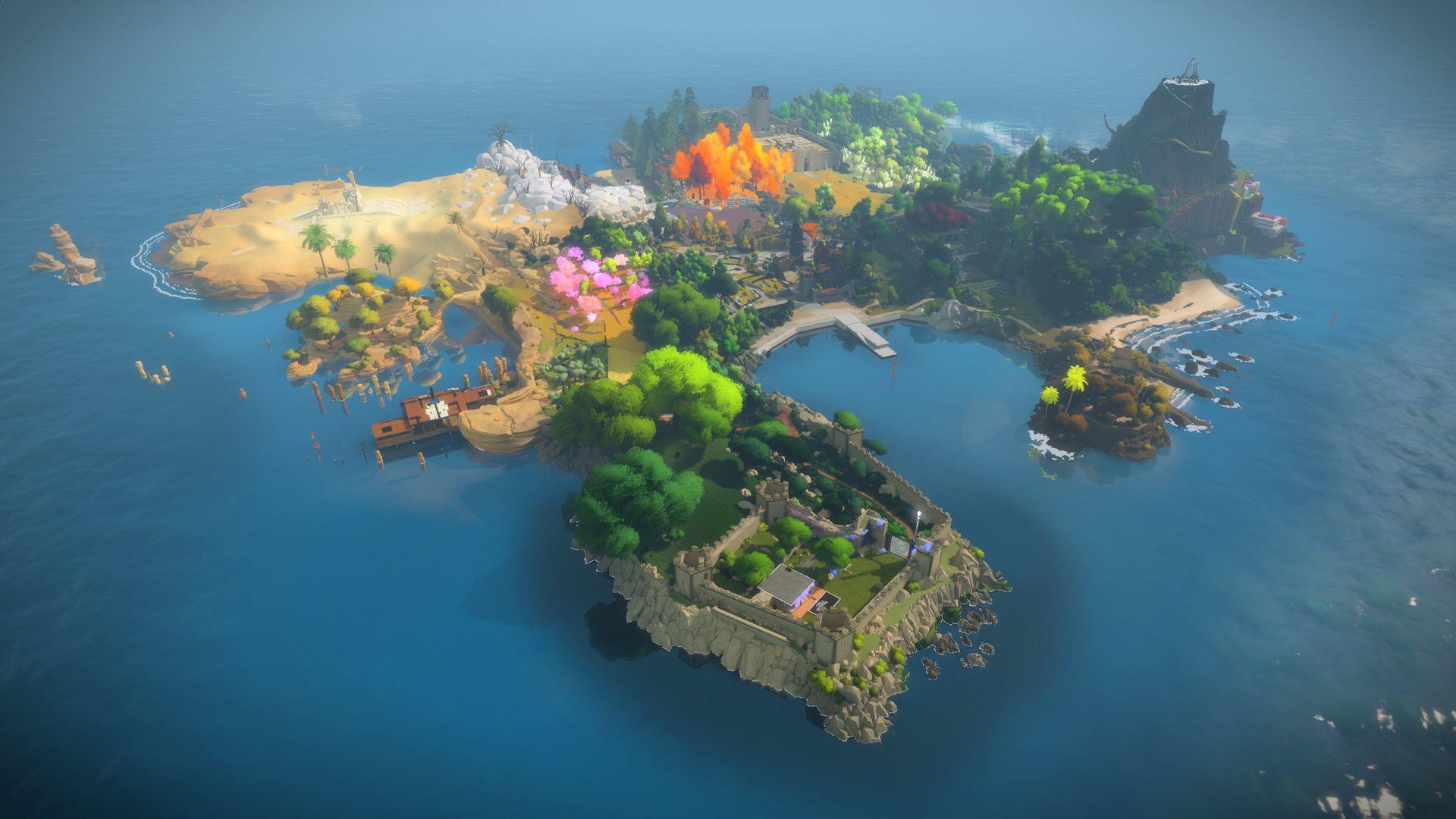
My name is Jonathan Blow, I’m a game designer from the USA. And the most recent game that I design was this game, the Witness, which came out in 2016. This game is of course still on sale in 2018 in places like steam. And we are noticing some very interesting things, for example, we have a lot of players from China who are interested in our game. So this graph here is a graph of the percentage of our players that come from each country. And USA is the first, 28%, but China is second with 15%, that’s like more than half the number of people from the USA, which is very large and very interesting. Also very interesting is the trend though because the game came out in 2016 and we can compare numbers. And you see here that back then China was a much smaller percentage. It was 4% and it was a number seven country. So in just two years, we’ve gone from this (2016) to this (2018), and that’s quite extreme.
So the Witness is not the only game seeing this pattern, many games in the west, both small independent games like mine and bigger AAA games are seeing the same kind of pattern. But something strange is that it’s a little bit different in China here. Game companies in China are certainly also benefiting from this growth but it’s mostly the big companies that are succeeding right, the army size companies; smaller independent companies have not been too successful yet. You might say that this is just the way China is and it’s not going to change, but I think it’s likely to change because it reminds me of a situation that we had in the west about 10 years ago.
Back then we made independent games. And in fact there’re people making independent games as we consider today even in the mid-to-late 1990s. But not very many people are paying attention to them. For sure main stream gamers were not playing them. They were just made for small audiences. And then around 2008, the market conditions changed. And indie games suddenly became popular and there is a huge explosion. So starting in 2008, and then through 2009, 2010 and 2011, there was this feedback loop of more and more games that were getting better and better, and getting larger and larger audiences at the same time.
Now to make this feedback loop, there’re two sides happening. On the gamer side, in 2008, with sort of the first time that many (disrupted by announcement of the stage). So starting in 2008 was the first time when a large number of gamers saw these examples of smaller games with still credible gameplay experiences that they really wanted to play. (Again disrupted by announcement of the stage) You know starting in 2008, gamers started to see these smaller games that were good enough that they could be interested in them legitimately right and not just playing them with wired reasons but like they’re real games that they would enjoy. And then of course in the subsequent years, as they saw more games, there was more and more evidence of this and more people became interested and those crowds were just built.
On the developer side, too, this wave of successful games in 2008 showed other developers that if they spend more time and money making games better, that they could succeed and make that money back. And also as these games got better and better, developers felt challenged to do better than the other developers.
Now I said a while ago that the market conditions changed in 2008. Well, just specify what those conditions were. First of all, we had a bigger audience as console and PC games had been getting more and more popular for years. Secondly, all those people had access to fast internet until they were able to download games. Whereas in previous years, if you wanted to download a game, you had to go to a store. And for a developer getting a game into a store is very hard and very expensive. Also at the same time, the supply of AAA games had been decreasing. Because these AAA games got more expensive to make, the big publishers consolidated their funds into making fewer games with higher budgets. But this meant that gamers were not getting as many different games as they actually wanted to play, and they weren’t getting as much varieties as they wanted because publishers were killing off older genres that were less successful. So this left a hole in the market that we, the new smaller companies, could occupy. But we couldn’t get there automatically. In order to get there, we had to do this forth item, which is increase the quality and sophistication of the games we were making so that gamers would recognize them as things that they wanted to play.
So in China I would bet that the conditions are about right for similar situation to occur. In China there’s a bigger audience than we had in the west and certainly many of those people have good internet. And also the AAA game situation is the same. So the main thing that is different is that quality and sophistication of independent games hasn’t yet jumped forward to occupy that niche.
Why Indie Games Matter
So some people might be thinking why does any of these matter, I don’t care that much about independent games, I just care about big AAA games, right, searching an open world for 200 hours. And the answer is because even if you just care about big games, the truth is that big games are not super good at being creative and giving you new ideas and experiences. Because when a game cost 100 million dollars to make, usually that money comes from a large institution, and that institution’s number one job is to make sure they don’t lose that 100 million dollars. And so they have to be very conservative in their decision making and do things that they think are probably going to be successful. And success or probably successful for game means doing something that somebody else has already proved to work by making a game that making a lot of money. And then we do that by changing a little bit like with better graphics or something.
On the other hand, if a game has a smaller enough budget, that the money can come from one person or a few people, those people can easily be motivated by something other than just making money. For example, they could just be excited about a new game idea or a new piece of style and that gives these games more room to experiment and try new things. And so together this makes a system. It’s like a conveyer belt where the new ideas start out in smaller games, they succeed or fail and then when they succeed, they get picked up and exploited by the bigger games. So if you really want bigger games to be good, you should care about smaller games being good.
So for examples of how that works, I can show a couple of games here. This game DOTA was originally a mod for Warcraft 3 and it became very popular and it respawned this entire field of similar games, some of which were tremendously successful. And the original ideas behind this game, PUBG, were originally tried in an ARMA III mod. And after several iterations now 2018 will be the year of more PUBG clones that you know what to do with. And these two examples are mods but it works the same way for full games.
Now when it comes to AAA games, and here I mean games for gamers, and ignoring mobile games for now. (laughter) It’s true! That wasn’t a joke, that is just how it is. So most of the successful games are made in a small number of places right now, the USA, Canada, Europe and Japan. So there’s something that I’m going to call the Voice of Games, which is something like the general attitude and aesthetic and ideas that come through from that collection of games as a whole. And that voice is created by the ideas of the people living in these countries that make the successful games. So the voice is a reflection of the culture of those counties specifically. And so usually for Chinese ideas or Chinese aesthetics to get into one of these games, it has to be an echo like it’s really how someone in Europe thinks that Chinese aesthetic is. It’s not really the real thing (direct expression) and you probably recognize it as distorted. So if you have ideas of what are interesting that are missing from this voice, the main way for them to get there is through this conveyer belt, starting in the small games, and then succeeding or failing, and then being picked up when they succeed by the big games.
Games are the Future of Human Thought
And all of that is important, because videogames are the future of human thought, and if you’re going to design the future of human thought, it’s a good idea to be careful. (Cheers) When we’re designing that thing, make sure to include all the best ideas from all cultures about how it should work.
Now some people might think that saying games are the future of human thought is a big statement so I’ll explain why that is. Back in the old days, when we wanted to learn something complicated like how to build a fire, we could do that by watching somebody who was good at performing that action, and by watching many times we could learn it. This ability to mimic and use tools is something that not many animals had and it made human beings very powerful in nature. But there’s a limitation to this kind of learning, which is that in order to watch someone build a fire, they have to have the wood, and the kindling and it has to be dry, because he can’t tell you about how to build a fire because we haven’t invented language yet.
But then eventually we do invented language, and that is a great technological advancement. By telling stories, we can talk about things that are far away, or that will happen in the future, or that already happened in the past, or things that are completely imaginary. And then later on we made another advancement in technology, which is writing. With writing, the guy trying to give you the information doesn’t have to be there. In fact, he could be dead and the information that’s being provided would stay the same for a long time. It doesn’t get distorted by constant retelling. So at first we use these marks to start talking about things where we had to be very specific like laws. And then eventually we developed a much more complicated theories of marks that let us talk about more complex and more subtle things about the world.
But we also developed the rich tradition of literature at the same time because not everything is just work, sometimes there’s enjoyment too. And then eventually we developed many other technologies, one of which is film. And in film, you have traditional storytelling techniques all available but also new things. For example, you have the position of the camera and the way light falls on the scene. And those things help you to communicate things that can be very subtle and nonlinguistic. So this technology gives us access to a kind of communication that we didn’t have before. And now one of the newest technologies is videogames.
And we all know that the difference between videogames and those older things is that games are interactive, and for the kinds of games we’re talking about today, you’re interacting with the computer that can do many calculations per second. And with those calculations, that computer is creating a system of some kind. So for example, if you trying to win the city building game, you might think ‘I want to build the sports stadium in a certain place in the city.’ But before you do that, you have to think ‘I’ve had a lot of things. How would this affect traffic in the neighborhood near the stadium? And how would that affect traffic going to the downtown retail district, which need to stay profitable to give people jobs and also slacking tax, slacking grow my city.’ And that’s just one line of thought that you can trace through this complex web of dependencies that comprise this whole system of this game.
Now the same thing is true even in games where you might not think it is so obvious. So to be successful in a game like PUBG, you have to have a very complicated system in your head. For example, where players are likely to be hiding, and how do that change at the beginning when there’s 90 people versus at the end when there’s 10 people. And how much is that going to change when there’s pressure from a circle coming in versus when everybody’s safe or when there’s an airdrop coming in versus when there’s nothing going on. So again by the time you’ve become good at this game you’ve become some kind of an expert at a complex web of interrelated facts. In other words, even if you didn’t think you’re learning anything real, you’re becoming good at system thinking and getting more experience at how complex systems are, how they behave.
Human beings lately really want to learn about systems but it’s hard. For example, if you wanted to learn economics which is the study of a big economic system, the best option you have so far is to read a book that will tell you a lot of facts about the system. But you don’t get to interact with an actual system, you have to use your imagination to make an imaginary system go, and your imagination could be wrong. It could misinterpret or extrapolate incorrectly what the book says. And also it just takes a really long time to learn in that way. Whereas if you’re playing a game for hours a day because you love it, you’re interacting directly every minute with a complex system, and you’re getting a very intimate feel of how that works. And this is very important because most of the problems that we face today as human beings are large, complicated, really difficult to confront problems, that require a high level of system thinking to approach. And so when I’m saying that games are the future of human thought, this is what I mean, it’s one of the next steps in this development of our ability to think about bigger things and deeper things and more complex things.
What to Do as a Developer
OK, so what is all these mean for people’s day to day life? For example, if you’re a game developer and you say ‘OK, how do I make a successful independent game, what should I do?’ Well, step number one is work hard, and I don’t think it’s a surprise to anybody but games are hard to make. The programming is difficult, making 3D graphics is difficult, but actually I think most difficult to all is design. Because the thing about design is you can’t really see it so it’s hard to judge when it’s right. And from experience we know that it’s very hard to make a good design and it’s actually very easy to make a bad design. So even though most parts of a game are very hard, I encourage you to put attention there on design.
Step two is you have to actually give gamers a reason to want your game. To you it’s special because you made it but gamers see thousands of thousands of games and yours is just one of those games. The big budget games solve this problem by spending a lot of money to make something impressive in scale or in visual glitz. But small companies can’t compete that way because we don’t have any or near as much money as they do, so we have to compete in a different dimension. And the one that always works for me is to make something special, you have to give people something that they’re never going to get from a game that costs a hundred million dollars. Well that’s not the only way to do it but it’s what I tried to do, but you have to do something.
And the third is to help each other out. Back in the 1990s and early 2000s in the USA when games were becoming very hard to make because they had gone 3D and we didn’t know how to do 3D yet. We were lucky to have adopted a really great attitude about communicating with each other. Somebody would go to a conference and say ‘I worked very hard to figure out this exact sequence of machine language instructions that will put graphics on the screen the most efficiently.’ And even though we were compe*****s, we would share that information with each other because we just liked each other and we wanted to help. And then we would go home from the conference and spend a few weeks figuring out this new piece of technology and then over the next month we would pass it and get better and by the next year we would show up at the conference much stronger and ready to do bigger things. So later on when the market for independent games is developed, you can compete rough and try to punch each other out, but for now, cooperation and lifting everybody up is probably the best strategy.
What to Do as a Gamer
OK so that’s for developers but what about for gamers, you know, what if you just play games? I would say first of all, understand the games are important. Even if you’re having fun while playing them that doesn’t mean that they’re meaningless. And you know people try to tell you that games are a waste of time. Don’t listen to them because it’s not true unless it’s a mobile game. (Laughter) Because again you’re developing this ability for system thinking and that is very important.
And I think very specific to China is that this is a time of very rapid expansion and so your choices will have a lot of influence. There’re a lot of people getting into gaming right now and when they try to find out about what they should be interested in, they’re going to learn from you, the people who already know what to be interested in. And what this means is that your personal tastes and your personal opinions will spread very easily and that gives you a great deal of power and influence. But just when you have influence like that, it’s a good idea to be careful and make sure that what you’re spreading is really the best thing.
And that’s all I have to say for the main presentation. Thank you for your time.
紫数 1年前
发布
黑狗布雷特 1年前
发布
闷骚菊 1年前
黑狗布雷特 1年前
闷骚菊 1年前
黑狗布雷特 1年前
闷骚菊 1年前
发布